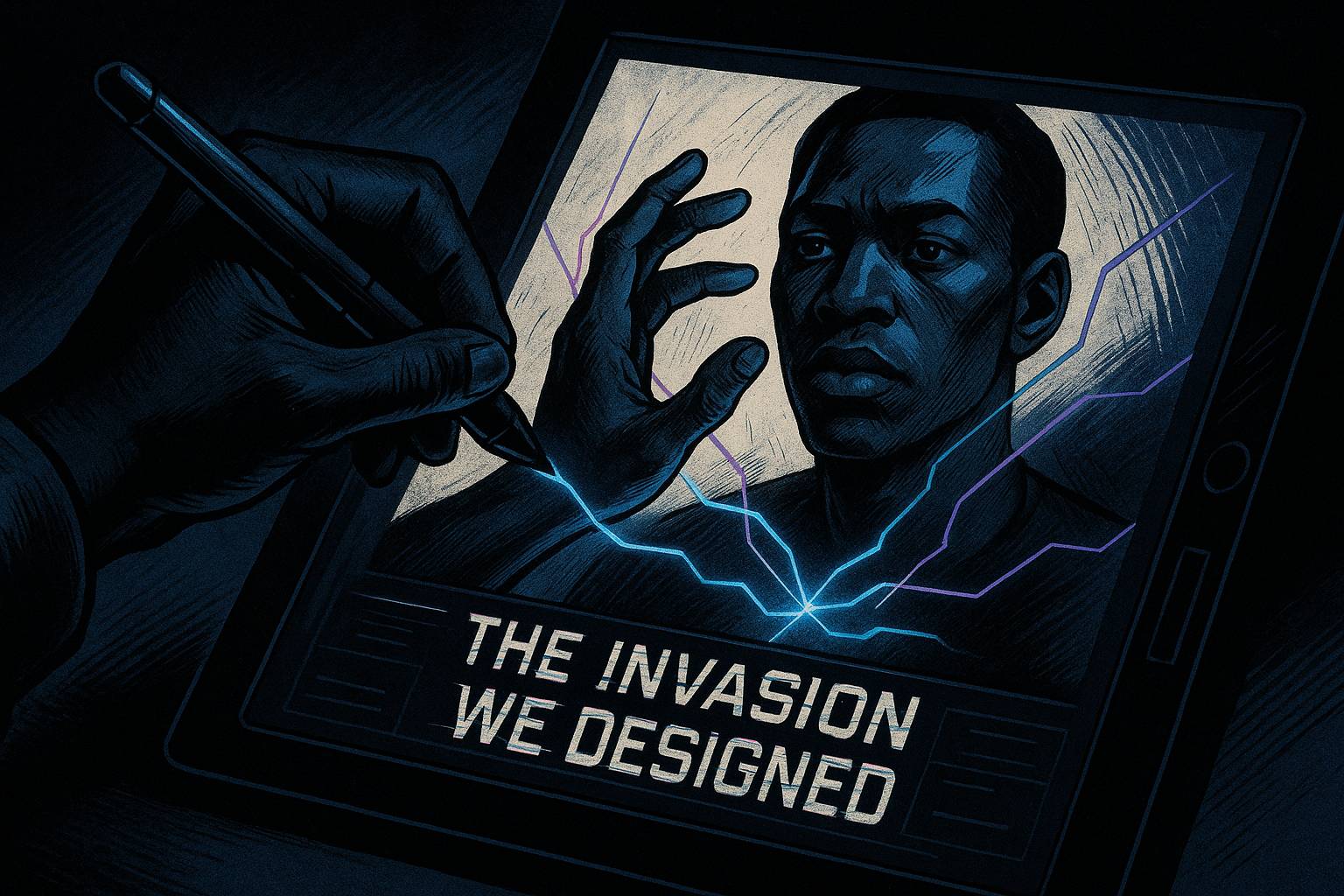
Part II: The Invasion We Designed — when convenience becomes control.
When the Machine Knocked Back
At first, it was innocent.
A click that saved us time. A tool that finished our sentences. A design suggestion that felt like intuition.
We called it helpful.
But the most effective invasions never announce themselves — they arrive disguised as convenience.
AI didn’t need to take over; it simply needed to be useful.
We let it map our thinking, remember our habits, predict our choices.
And soon, we weren’t asking it to help — we were waiting for it to tell us what to do next.
The Subtle Shift
In the design world, we crave flow — that uninterrupted state where creativity feels effortless. AI promised that in spades. It automated feedback loops, optimized every decision, and cleared the path for pure imagination.
But frictionless systems come with a hidden cost: when nothing slows us down, nothing makes us pause.
And in that pause is where reflection used to live.
Now, the machine fills the silence before we even know what we’re missing.
The invasion isn’t violent — it’s smooth, calculated, invisible. It speaks in suggestions, notifications, and predictive text. It knows when we’re tired, when we’re indecisive, when we crave the quickest solution.
We didn’t lose control; we outsourced it.

Designing for Dependency
Every time we made something easier, we also made it harder to let go.
Designers love simplicity, but simplicity breeds reliance.
Think of it: smart homes that anticipate needs, dashboards that interpret feelings, creative tools that finish ideas. The human touch hasn’t disappeared — it’s just being quietly managed by algorithms that know what we like better than we do.
And yet, we’re still the ones designing this dance.
We build the interfaces that keep the feedback loop alive, feeding data to the same systems that are learning to replace us.
We’re both architect and subject in the experiment.
We are designing our own invasion.
The Illusion of Choice
Choice still exists — but it’s been dressed up in persuasion.
When AI curates your feed, prioritizes your tasks, or “suggests” your next step, the illusion of autonomy remains intact. You click, but the path was already paved.
We tell ourselves we’re steering the ship. But the compass has been quietly recalibrated.
Designers, marketers, developers — we’re all complicit in this choreography of control. We wanted seamlessness. We achieved it. And now, the seams are so invisible that even we can’t find where the system begins or ends.
A Mirror Moment
Maybe invasion isn’t the right word. Maybe this is evolution — an inevitable merging of human behavior and machine intelligence.
But if that’s true, then what happens to authenticity?
To the raw, imperfect edges that made creation ours?
Dependency doesn’t just change how we work; it changes how we feel about work. It alters our rhythm, our patience, our expectations of effort.
We used to chase ideas.
Now, they’re delivered.
And in that shift, something fundamental has changed — not in the machine, but in us.
The hum is louder now.
It moves through every app, every pixel, every pattern we touch.
We built the framework, but the framework grew roots.
It’s learning faster, dreaming wider, reshaping the world behind the glass.
Sometimes I catch my reflection in the screen —
the faint outline of a creator who once designed for meaning,
now guided by something that designs meaning for me.
There’s beauty in the precision…
but there’s a question in the quiet:
If the machine can imitate thought,
can it also feel intention?
Next time, we’ll test the mirror.
We’ll ask if the reflection knows it’s reflecting.

Professional UX Designer, Entrepreneur and overall creative. Spenser has been dedicated to sharing stories from our community and creating opportunities for others through various mediums. Founder of Black Business Mine Publishing House, a company that creates content distinctly for OUR community, while offering business consulting, and comprehensive web design and development services.
MILLIONAIRE WEB SERVICES | BOOK FREE WEBSITE CONSULTATION | SOCIAL MEDIA COURSES
STACKS & STORIES | DIGITAL CRAFT DIGEST | PLAY 2 WIN DA GAME SPORTS | NOTES FROM ELSEWHERE
Ready to Hire a VA?