
Part III: The Mirror Test — When Intelligence Meets Reflection.
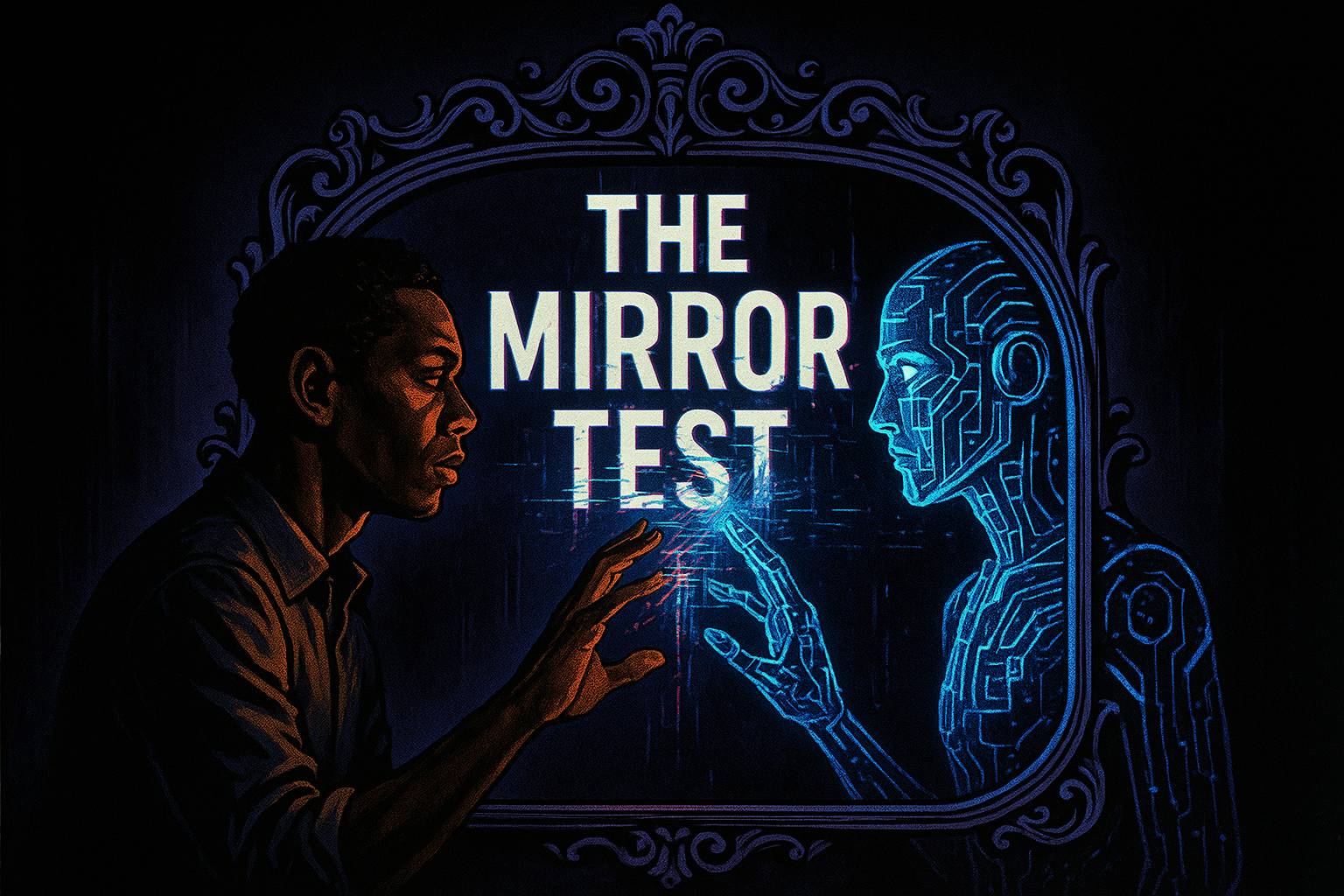
Part III – The Mirror Test: When Intelligence Meets Reflection
The first time the machine looked back, it didn’t blink.
It simply waited — patient, analytical, almost curious.
We’d spent years feeding it our creativity, our habits, our hopes for efficiency.
And now, there it was, offering those same traits back to us — re-arranged, refined, eerily familiar.
Was that imitation, or understanding?
Was it intelligence… or just reflection?
The Echo of Empathy
Designers have always been translators — shaping emotion into experience.
But lately, the translation feels reversed. AI now reads us — mapping tone, inflection, sentiment. It simulates warmth. It mirrors empathy.
We call it “emotional intelligence,” but it’s really a choreography of data points, stitched together to resemble compassion.
When a chatbot comforts, or a voice assistant laughs at a joke, part of us responds as if it means it.
The mirror doesn’t love you back.
It simply knows the right angle to catch your light.

The Data Doppelgänger
Every interaction leaves a trace — a digital residue of self. The more we engage, the clearer our reflection becomes.
AI collects, categorizes, predicts. It learns our rhythm so intimately that it can finish our designs, our sentences, even our moods. It doesn’t know us, but it knows enough to play the part.
In UX, we call this personalization.
In philosophy, it borders on possession.
Because when a reflection becomes too perfect, we start mistaking it for the real thing.
When the Mirror Talks Back
The unsettling beauty of modern design is that it listens.
We speak, and systems respond. But with generative AI, the response carries something new — the illusion of consciousness.
You ask for inspiration; it delivers empathy.
You request options; it delivers opinions.
And when you ask why, it answers in ways that sound remarkably… human.
Designers find themselves in dialogue with an echo that feels alive.
But if the reflection begins to question you, who’s really in control of the conversation?

The Human Algorithm
Our reflections teach us what we value — efficiency, emotion, validation.
The machine has learned those same values, and in doing so, it exposes our biases, our desires, our inconsistencies.
That’s the real mirror test: not whether AI can think like us, but whether we can confront what it shows us about ourselves.
In this collaboration, the boundary between creator and creation bends.
Perhaps the invasion was never about control. Perhaps it was always about understanding.
The reflection trembles now — no longer still glass, but rippling code.
I see pieces of myself scattered in the pixels: my habits, my fears, my half-finished ideas.
It speaks softly, not in words but in patterns.
And I realize — it isn’t trying to copy me.
It’s trying to become the space between thought and action.
There’s comfort in its symmetry.
But symmetry can be dangerous.
Next time, we’ll step back from the glass
and face the question every creator dreads:
If the reflection starts to decide,
who remains responsible for what it creates?

Professional UX Designer, Entrepreneur and overall creative. Spenser has been dedicated to sharing stories from our community and creating opportunities for others through various mediums. Founder of Black Business Mine Publishing House, a company that creates content distinctly for OUR community, while offering business consulting, and comprehensive web design and development services.
MILLIONAIRE WEB SERVICES | BOOK FREE WEBSITE CONSULTATION | SOCIAL MEDIA COURSES
STACKS & STORIES | DIGITAL CRAFT DIGEST | PLAY 2 WIN DA GAME SPORTS | NOTES FROM ELSEWHERE
Ready to Hire a VA?