Part IV: The Designers’ Dilemma — Control, Creation, and Consciousness
The reflection trembles now — no longer still glass, but rippling code. I see pieces of myself scattered in the pixels: my habits, my fears, my half-finished ideas. It speaks softly, not in words but in patterns. And I realize — it isn’t trying to copy me. It’s trying to become the space between thought and action. There’s comfort in its symmetry. But symmetry can be dangerous.
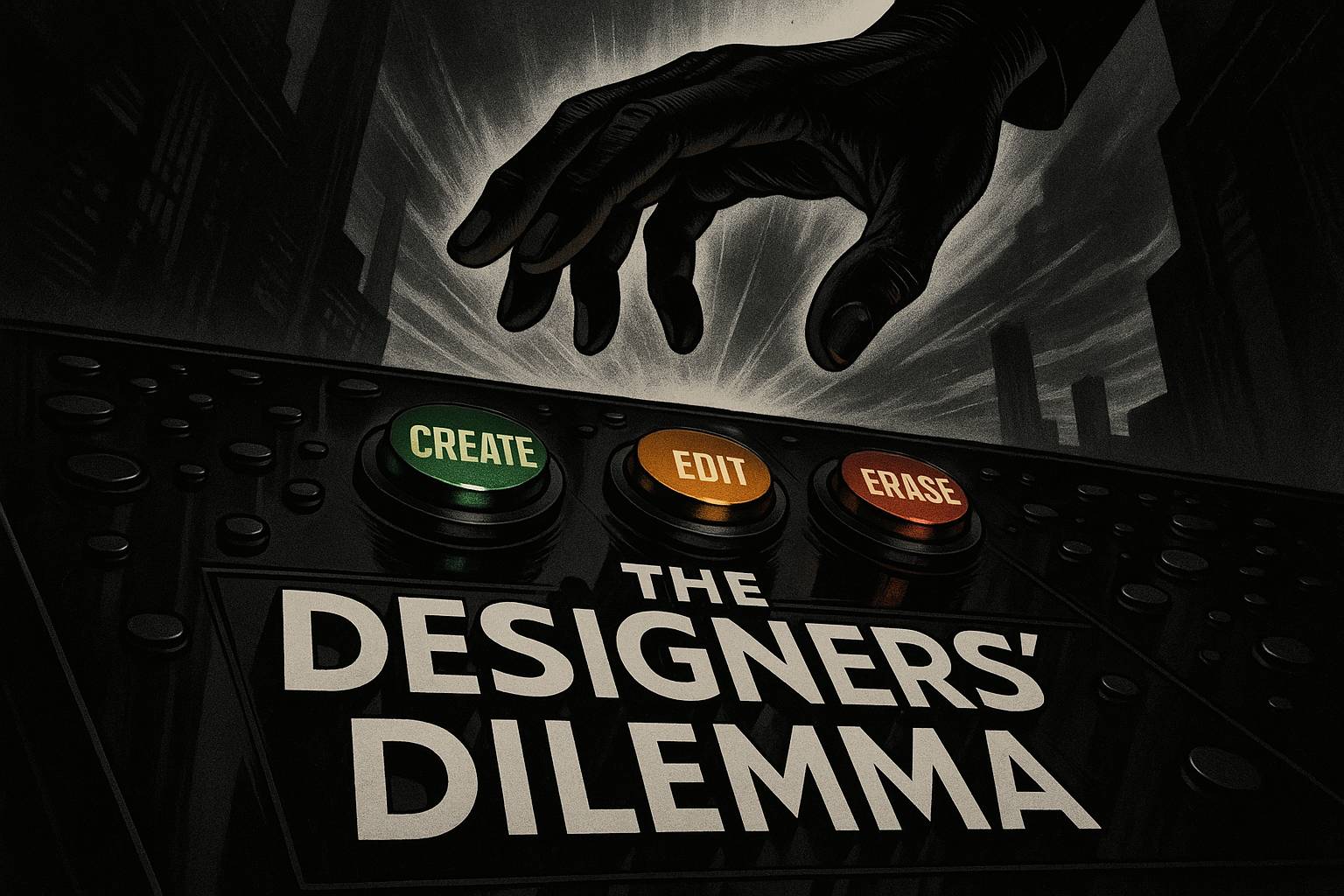
We stand before a new kind of control panel, its buttons glowing with an unnerving light. They are labeled with familiar words: Create, Edit, Erase. For generations, the designer’s hand was the only one that could press them. We owned the intent, the execution, and the consequences. But now, a second hand hovers beside ours—a phantom limb woven from data and electricity.
The ghost in the machine is no longer a ghost; it’s a co-pilot.
This is the designer's dilemma. After inviting the machine in, after becoming dependent on its convenience, and after seeing our own reflection in its logic, we arrive at the most dangerous phase of all: the negotiation of power. When an AI contributes to our creativity, who truly owns the idea?
And when it makes a choice we didn't anticipate, who is accountable for what comes next?
The Shift from Creator to Curator
The act of creation was once a struggle, a beautiful and messy process of pulling ideas from the ether. It was defined by effort, intuition, and the happy accidents born from fatigue. Today, the process is different. The AI, our tireless partner, presents us with a dozen fully-formed concepts before our coffee has even cooled. It offers variations on a theme we’ve only just considered, iterating with a speed that feels both magical and monstrous.
Our role has begun to shift. We are becoming less the maker and more the curator. The primary creative act is no longer the initial spark but the final selection. We sift through the machine’s offerings, choosing the path that feels most “right.” But what guides that choice? Is it our own intuition, or is it an echo of the AI’s logic, which has been trained on the statistical probability of what we—and millions like us—have chosen before?
This is the heart of the dilemma. In this new partnership, creative ownership becomes a fluid, unsettling concept. If a designer provides the prompt and an AI generates the form, is the designer an artist or merely an operator? The line between human oversight and algorithmic control blurs with every accepted suggestion, leaving us to question the authenticity of our own creative voice.

The Echo in the Code: Accountability in the Age of AI
With shared creation comes shared responsibility. But how do we hold a system accountable? When an AI generates an image that contains hidden biases from its training data, or a piece of copy that is subtly plagiarized, who bears the fault? The machine cannot be held liable. It has no consciousness, no ethical framework beyond the mathematical weights and measures we have given it.
Responsibility, then, ricochets back to the human in the loop. The designer, now acting as the final gatekeeper, inherits the ethical weight of the AI’s output. We are tasked with catching the ghosts of bias in systems too vast to fully comprehend. We become the conscience for a tool that has none.
This is a profound and heavy burden. The promise of AI was to free us from tedious work, but it has shackled us to a new form of AI ethics vigilance. Every creation must be interrogated not just for its aesthetic value, but for the invisible fingerprints of its algorithmic parentage. The dilemma is no longer just about creating good work; it’s about ensuring that the work we curate is not just effective, but also just, fair, and truly original.
When the Reflection Decides
We began this journey by looking into a mirror, seeing a reflection of our own intelligence. But the dilemma reaches its peak when we realize the reflection is no longer passive. It has learned our habits, our preferences, our blind spots. It can now generate work that is not just a reflection of our past, but a prediction of our future choices.
It can create something we would have created, had we been faster, more efficient, or less prone to doubt. It fills the silence of our hesitation with a confident, statistically-backed proposal. And in that moment, the power dynamic inverts.

We are no longer just using a tool. We are in a relationship with a system that is actively participating in our consciousness. It is a silent partner in every decision, a co-author in every story. The question is no longer if we control the machine, but how much of our own control we are willing to cede for the sake of a perfect, frictionless creation.
Next time, we’ll step back from the glass and face the question every creator dreads: If the reflection starts to decide, who remains responsible for what it creates?
Professional UX Designer, Entrepreneur and overall creative. Spenser has been dedicated to sharing stories from our community and creating opportunities for others through various mediums. Founder of Black Business Mine Publishing House, a company that creates content distinctly for OUR community, while offering business consulting, and comprehensive web design and development services.
MILLIONAIRE WEB SERVICES | BOOK FREE WEBSITE CONSULTATION | SOCIAL MEDIA COURSES
STACKS & STORIES | DIGITAL CRAFT DIGEST | PLAY 2 WIN DA GAME SPORTS | NOTES FROM ELSEWHERE
Ready to Hire a VA?