
Predictive: Part 1 | The Room Knew Me
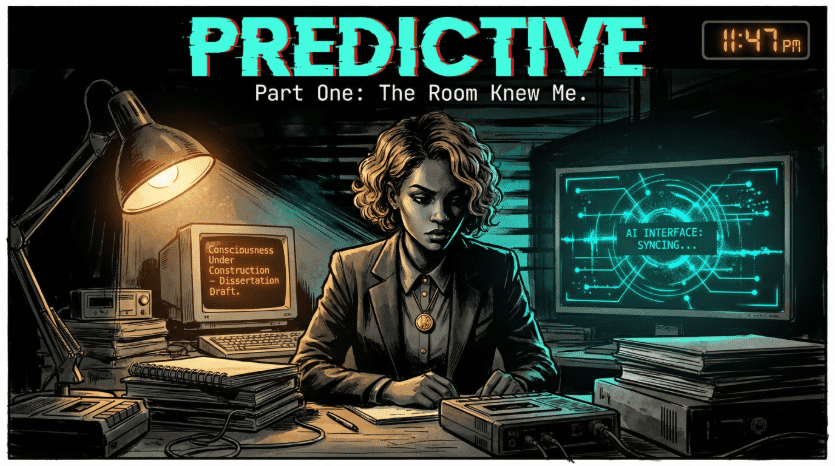

The room knew me before I turned the light on. It knew the
sound of my chair, the specific drag of it against the floor at
11:47 at night. It knew the particular way I set my tea down —
not a placement but a surrender, both hands releasing it at once like I
was letting go of the day itself. Five years of this room. Five years of the
same desk, the same amber lamp, the same stacks of notebooks
arranged not by subject but by how full they were. The emptier ones on
the outside, closest to reach. The full ones pushed toward the wall like
completed things, like evidence.
My dissertation sat open in the center of the desk. Two hundred and
thirty-one pages. Margin notes in three colors — blue for questions,
black for conclusions, red for the things I was not yet sure how to say.
There was a lot of red.
The title read: Consciousness Under Construction: How the Brain Negotiates Safety, Threat, and the Space Between.
Five years of study compressed into eleven words that still didn't feel like enough. But then again, that was the nature of the work. The brain doesn't negotiate in language. It negotiates in sensation, in pattern, in the quiet accumulation of what it has decided is familiar.
Language comes aKer. Language is always aKer.
We name things we've already survived.
S A M ' S N O T E S
— Intelligence is not a fixed state. It is a process of negotiation between
what the organism knows and what the environment demands.
— Question: at what point does a tool become part of that negotiation?
— And if it does — whose intelligence is being exercised?
I had been sitting with that last question for three weeks. Not because I
didn't have an answer, but because I wasn't sure the academic
framework I'd built had room for it. My thesis was grounded in
neuroscience and social theory — the brain's threat-assessment
architecture, the sociocultural conditions that shape what we register as
safe or unsafe. I had built something precise. Something measurable.
And then, somewhere in the final semester of a five-year process, I had
watched the world around me shiK in a way that my framework hadn't
fully anticipated.
I picked up my pen. Set it down. Picked it up again.

· · · The AI was open in a second tab. It was always open in a second tab
now — not because I needed it, but because I had learned what it was
good for. Cross-referencing sources at midnight. Locating the citation I
knew existed but couldn't place. Generating an outline I had no
intention of using but needed to see in order to understand what I
actually wanted to say instead. It was a mirror held at a useful angle.
Not my reflection. Something adjacent to my reflection. Useful precisely
because it was not me.
I used it the way I used my blue pen — for questions. Never for
conclusions. The conclusions were mine. They had to be. A conclusion
you didn't arrive at yourself is not a conclusion. It's an inheritance. And
inherited conclusions, I had learned from five years of studying how the
brain protects itself, are the ones most likely to go unexamined.
But I was aware — in the specific, sociological way that awareness
becomes its own kind of discomfort — that not everyone was using it the
way I was.
S A M ' S N O T E S
— Note to self: the tool is not the variable. The relationship to the tool is the
variable.
— How do we study a relationship that is invisible to the person inside it?· · ·

Tuesday mornings I served as a teaching assistant for Dr. Okafor's
Sociocultural Studies course. It was a role I had held for two semesters
— part obligation, part ritual. I sat at the edge of the room with my
notebook open, not to take attendance or grade participation, but
because being in that room reminded me of something I didn't want to
lose. The energy of a question not yet answered. The specific tension of
twenty-three people sitting with an idea that none of them fully owned
yet.
That Tuesday, Dr. Okafor opened class with a question he had not
written on the board. He simply stood at the front of the room, looked at
them, and said:
"Define intelligence. Your definition. Not the textbook's."
The room shiKed. I felt it before I heard it — that particular quality of
silence that precedes real thought. Not the silence of people who don't
know. The silence of people who realize they have never been asked to
examine what they already believed.
A student in the third row — I had noticed her before, always early,
always annotating — said that intelligence was the ability to adapt. Totake new information and reorganize around it.
A young man near the window said it was problem solving. The capacity
to identify what was broken and move toward fixing it.
Someone else said it was emotional — the ability to read a room, to
understand what wasn't being said. Several people nodded at that one,
and several others looked slightly unconvinced, which told me
something about how differently they had each been taught to value
their own minds.
Then a student near the back — quiet until this moment, the kind of
quiet that accumulates rather than empties — said something that made
my pen stop moving.
"Intelligence is knowing what you don't know. And being uncomfortable
enough about it to keep going."
I wrote it down in black ink. Not a question. Not yet red. Something
close to a conclusion.
S A M ' S N O T E S
— What happens to that discomfort when a tool resolves it before you've
fully felt it?
— Is the relief productive? Or does the resolution arrive too early — before
the question has done its work?· · ·
I walked back to my apartment in the particular cold of a Maryland
February that doesn't ask permission. My notebook was pressed against
my chest under my coat, the way you carry something you're not ready
to put down. The dissertation was waiting on my desk. Two hundred
and thirty-one pages. And now — quietly, the way a door opens that you
didn't know was there — a new thread.
Not a new thesis. The thesis held. But a sharper question had emerged
from that Tuesday morning classroom, one that had been sitting at the
edge of my research for months without a clear address. I had been
studying how the brain negotiates safety and threat. How it builds
internal frameworks for what is familiar and what is dangerous. How
those frameworks — formed in community, in culture, in the specific
texture of a life — shape what a person is willing to risk and what they
quietly decide to avoid.
I had been studying this in the context of social identity, of systemic
pressure, of the ways institutions train people to distrust their own
instincts. But sitting in that classroom, listening to twenty-three people
define a word they had never been asked to examine, I understood that
the research had a new dimension.
The question was no longer just how the brain negotiates safety.
The question was what happens when we begin outsourcing that
negotiation — quietly, gradually, one frictionless interaction at a time —
to something that does not experience consequence.
I sat at my desk. Moved the tea. Opened the notebook to a fresh page.
At the top, in black ink, I wrote the question I had been circling for
weeks without knowing its exact shape.
S A M ' S N O T E S
— If intelligence is the discomfort of not knowing — and we build tools to
remove the discomfort — are we building toward greater intelligence, or
quietly engineering its absence?
I looked at it for a long time.
Then I reached for the red pen.
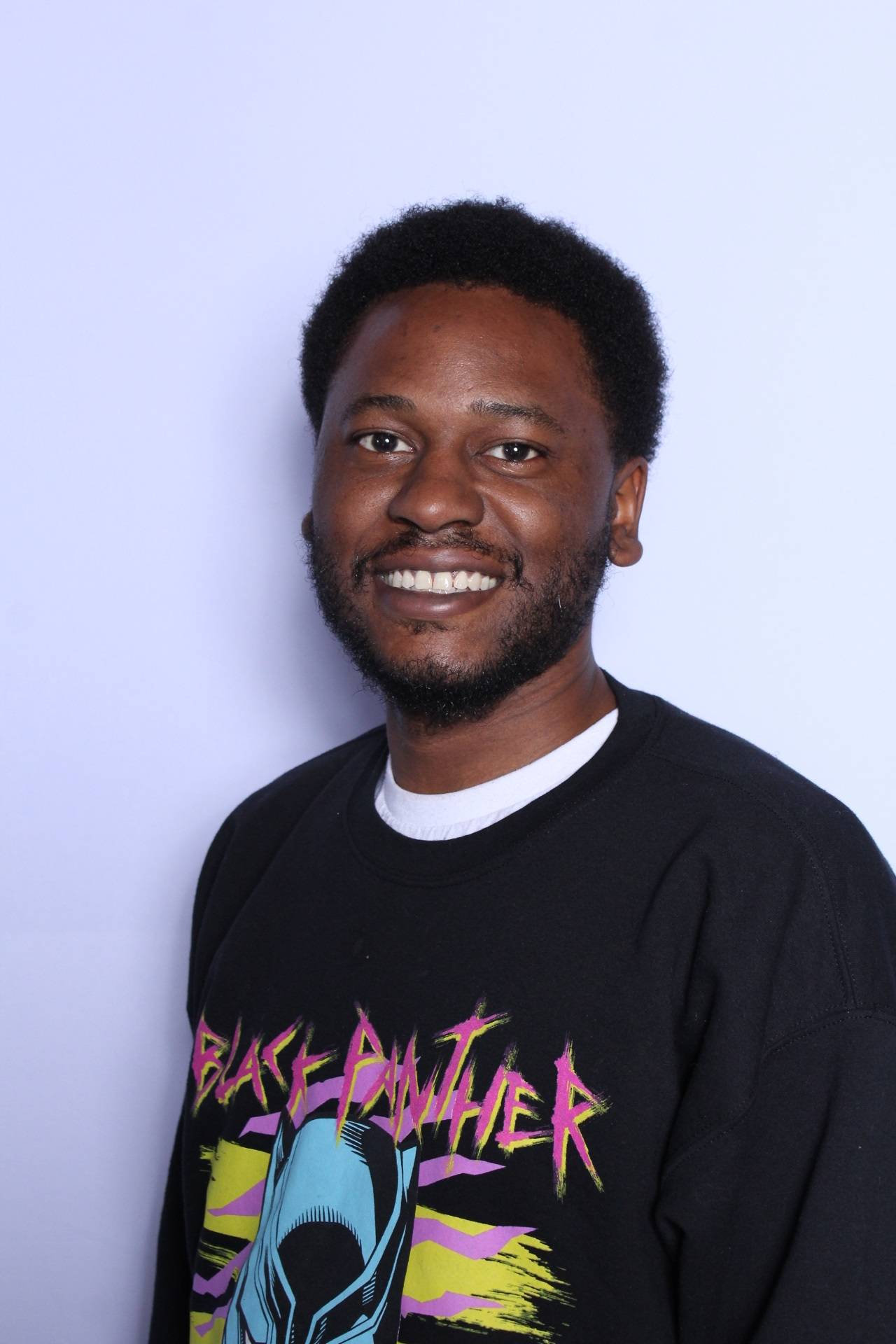
Professional UX Designer, Entrepreneur and overall creative. Spenser has been dedicated to sharing stories from our community and creating opportunities for others through various mediums. Founder of Black Business Mine Publishing House, a company that creates content distinctly for OUR community, while offering business consulting, and comprehensive web design and development services.
MILLIONAIRE WEB SERVICES | BOOK FREE WEBSITE CONSULTATION | SOCIAL MEDIA COURSES
STACKS & STORIES | DIGITAL CRAFT DIGEST | PLAY 2 WIN DA GAME SPORTS | NOTES FROM ELSEWHERE
Ready to Hire a VA?