
Predictive: Part 2 THE CLARITY / THE SHFIT
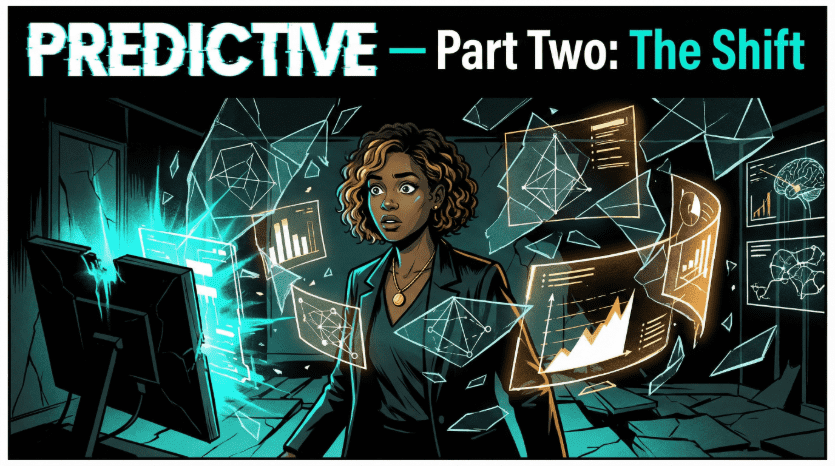
The Clarity
The red pen stayed uncapped for three days. Not because I didn't
know where to start, but because I had learned — in the
particular way that five years of research teaches you — that the
first sentence of a new direction is not something you force. It arrives.
You just have to keep the conditions right for it. So I leB the pen
uncapped. I kept the notebook open. I went to class, made tea, walked
the long way back from the library in the February cold, and I waited
for the thought to finish forming itself.
It came on a Thursday evening, quietly, the way the important ones
always do. Not as a statement. As an image.
I was watching a graduate student at the table across from me in the
library — someone I didn't know, hadn't spoken to — and she was
working with that particular intensity that erases everything around it.
Headphones in. Four textbooks open at angles. A laptop with what
looked like twelve tabs competing for her attention. And beside it all, a
single yellow legal pad covered in handwriting so dense it looked like
texture from a distance. She wasn't using any shortcuts. You could see itin her posture — the slight lean forward, the pen moving constantly
between her hand and the page and back again. The labor was visible.
The struggle was right there on the surface of her face, and she wore it
the way you wear something you chose.
Two tables over, a young man was leaned back in his chair at an angle
that suggested either supreme confidence or the particular comfort of
someone who has already solved for the hard parts. Laptop open. One
tab. He typed a question, read the response, typed another. The rhythm
of it was almost musical — prompt, receive, refine, move on. He looked,
from the outside, like someone who was also working very hard. And in
a real sense, he was. Just on a different layer of the problem.
I sat between them and understood, suddenly and completely, what my
dissertation had been missing.
S A M ' S N O T E S
— The thesis was always about the brain negotiating safety. But I was
looking at the negotiation from the inside out.
— What if I looked at it from the environment in? What does the tool
change about the conditions of learning — not just for the person using it,
but for the entire ecosystem they inhabit?
— Two people. Same room. Same semester. Different relationships to the
same technology. What does that cost each of them? What does it give?· · ·
I went home and uncapped the red pen and wrote for four hours
without stopping.
The framework that emerged wasn't a departure from my original
thesis. It was, I realized, the part my thesis had always been building
toward without knowing it. I had spent five years mapping how the
brain creates internal safety architecture — the neurological scaffolding
we build from experience, consequence, and the specific friction of
navigating a world that doesn't accommodate us evenly. My argument
had always been that this scaffolding is not passive. It is constructed. It
requires challenge to develop the way muscle requires resistance. You
do not build cognitive resilience by avoiding difficulty. You build it by
moving through difficulty slowly enough to integrate what you learn.
The new question wasn't a contradiction of that. It was the next logical
step.

THIS IS FRAMEWORK
If the brain builds its safety architecture through the friction of experience
— through the sustained discomfort of not yet knowing — then what
happens to that architecture when a tool systematically removes the friction
before the building can occur?And further: what is the sociocultural cost when this removal is uneven —
when some members of a shared environment are building with friction
while others are operating without it, and both are being evaluated by the
same institutional standard?
That second question was the one that kept me up. Because it wasn't just
about individual learning. It was about the equity of cognitive
conditions inside a shared academic space. Two students sitting in the
same classroom, being graded on the same rubric, developing their
minds at structurally different rates and in structurally different ways —
and the institution seeing neither the difference nor the cost.
I wrote that down in black. Then I circled it in red.
· · ·
The methodology almost designed itself once the framework was clear. I
needed two subjects. Not extremes — not a cautionary tale on one side
and a success story on the other. That would be editorializing. What I
needed were two people genuinely navigating the same semester, in the
same environment, with different relationships to the same available
tool. One who used it as a primary resource. One who didn't use it at all.
And I needed to follow them not just academically — grades, outputs,deliverables — but humanly. Sleep. Relationships. The parts of a person
that don't show up in a transcript but tell you everything about what the
work is actually costing.
I also needed, if I was being honest with myself, subjects I already had
some window into. Observational research at this level of intimacy
requires a baseline. You have to know what someone looked like before
the semester started in order to see what the semester has done to them
by the end.
There were two people who came to mind immediately.
· · ·
I had known Demi in the way you know people who move through a
space with a particular gravity. She was a second-year graduate student
in SoBware Engineering — one of a handful of Black women in her
program, which itself said something about the kind of endurance her
daily environment required. I had seen her in the library oBen enough
to recognize her rhythm. She arrived early and leB late. She kept paper
notebooks alongside her laptop the way I did, which made me notice
her in the first place. There was a project she was building — she had
mentioned it once in passing during a conversation near the coffee
station, a brief exchange that had stayed with me because of the way
her voice changed when she described it. An application addressingsocial mistrust in the news. Something about giving people tools to
interrogate the information they consumed rather than simply receiving
it.
It was, I thought, a deeply sociological problem expressed in code. And
she was carrying it alone.
S A M ' S N O T E S
— Demi. SoDware Engineering, Year 2. Building something that matters.
No AI tools — confirmed in conversation. "I want to understand what I'm
building, not just that it works."
— That sentence. Keep it.
Jason I knew from Dr. Okafor's course — he was an IT major who sat
near the window and had given that early definition of intelligence as
problem solving. He was sharp in conversation. Quick to find the
practical angle on any theoretical question, which the room appreciated
even when it occasionally collapsed nuance into efficiency. He had a
fluency with AI tools that went beyond casual use — he had mentioned,
almost offhandedly, that he had built bots to handle several of his
routine assignments. Not to cheat, exactly. More to redirect his attention
toward the layers of the work he found genuinely interesting. He was, in
his own way, a kind of engineer too. He was optimizing his academic
experience the same way a developer optimizes a system.
Removing friction. Automating the predictable.
Reserving his actual bandwidth for the problems he hadn't already solved.
The question I had about Jason wasn't whether he was capable. He
clearly was. The question was what he was becoming capable of — and
what he might be quietly becoming less capable of — in the space his
automation had cleared.
S A M ' S N O T E S
— Jason. IT major, undergrad. Heavy AI integration across coursework.
Intelligent, efficient, comfortable. Watch for what comfort costs.
— Note: he is not the villain of this study. Neither is Demi the hero. That
framing would make the data useless.
· · ·
I submitted my amended methodology to my dissertation chair, Dr.
Reyes, on a Tuesday morning — the same morning, as it happened, that
I sat in Dr. Okafor's classroom and watched his students argue
cheerfully about whether emotional awareness counted as a form of
intelligence. Dr. Reyes approved it with two margin notes. The first was
a citation suggestion. The second, written in her particular compressed
handwriting at the bottom of the page, read simply: This is the right
question. Be careful not to answer it before you've asked it fully.I read that twice. Taped it to the inside cover of a new notebook — the
emptiest one, the one closest to reach.
The semester had already begun. Demi and Jason were already inside it,
already making the daily decisions that would, by May, tell me
something I didn't yet know how to say. I would follow the distance
between them not to judge it, but to measure it. To understand what it
meant about the environment that produced them both and asked them
both, at the end of sixteen weeks, to prove the same thing.
I opened the notebook. Wrote the date at the top of the first page.
And I began.
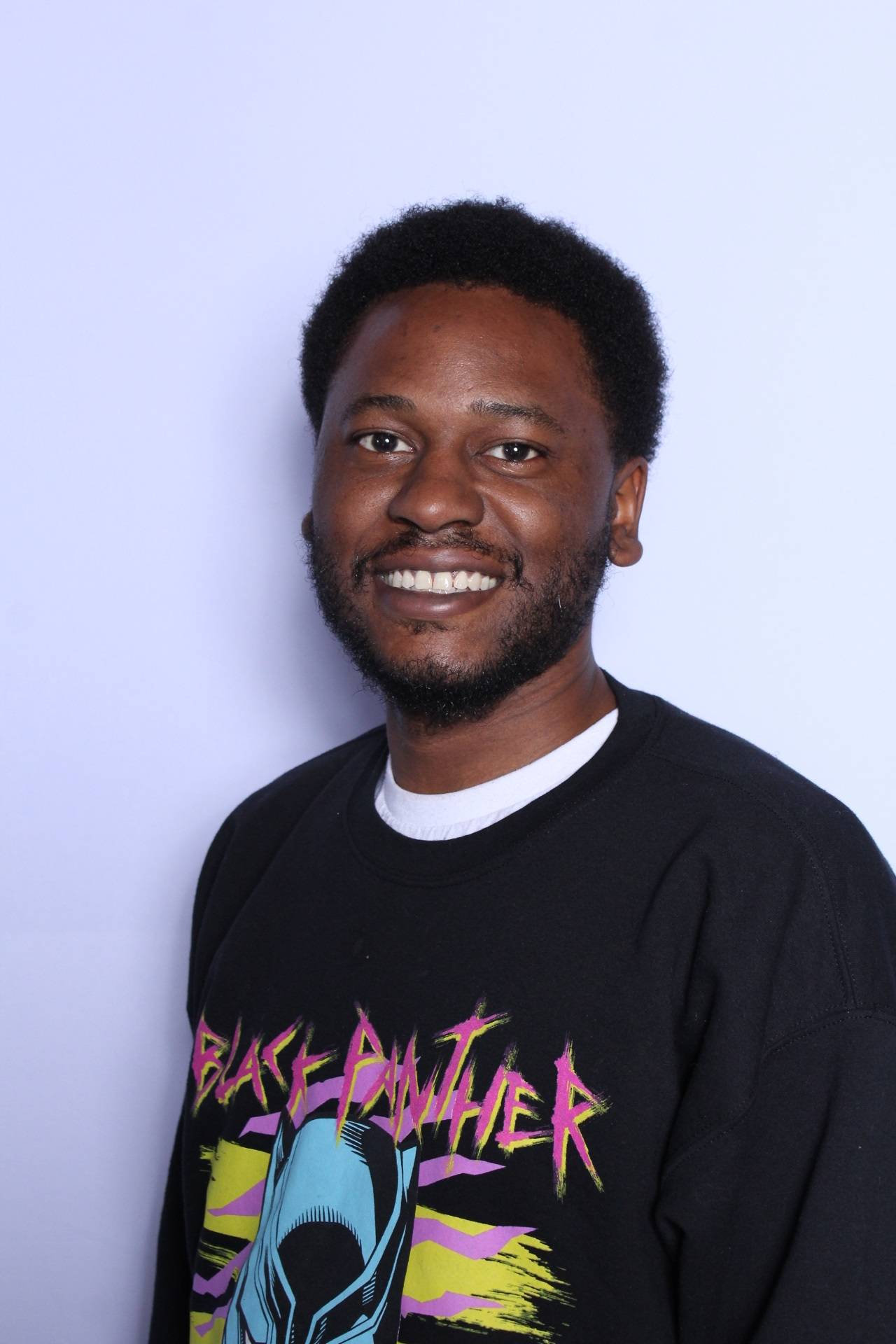
Professional UX Designer, Entrepreneur and overall creative. Spenser has been dedicated to sharing stories from our community and creating opportunities for others through various mediums. Founder of Black Business Mine Publishing House, a company that creates content distinctly for OUR community, while offering business consulting, and comprehensive web design and development services.
MILLIONAIRE WEB SERVICES | BOOK FREE WEBSITE CONSULTATION | SOCIAL MEDIA COURSES
STACKS & STORIES | DIGITAL CRAFT DIGEST | PLAY 2 WIN DA GAME SPORTS | NOTES FROM ELSEWHERE
Ready to Hire a VA?