Part 3: Directing the Digital Ensemble — The Art of Sonic Architecture
The studio is quiet, save for the hum of the processor and the soft, rhythmic tapping of keys. The water-damaged notebook, salvaged from the 2017 flood, rests beside the keyboard. Its pages are filled with the raw, unedited poetry of my youth. In Part Two, we discussed the painstaking process of translating those written words into a phonetic structure the machine could understand. We learned how to write the sheet music for a ghost.
But sheet music is only a blueprint. To build a house, you need an architect. To build a band, you need a director.
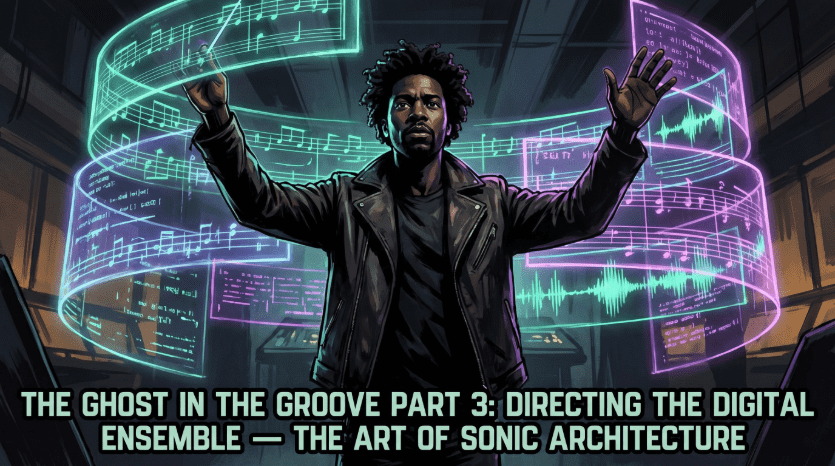
When I created K@MECRZE, I was not just feeding lyrics into an algorithm and hoping for the best. I was stepping into a new role. As a recording artist with seven albums and four mixtapes under my belt, I was used to being the performer. I was used to standing in the booth, feeling the beat, and letting the emotion dictate the delivery. But in the digital studio, the dynamic shifts. You are no longer the vocalist; you are the creative director. You are the conductor of an ensemble made entirely of code.
And directing a digital ensemble requires a profound shift in perspective. It requires you to stop thinking like a singer and start thinking like a sonic architect.
The UX of Sound
In my day job as a UX designer, my primary goal is to guide a user through a digital experience. I use color, typography, and layout to create a journey that feels intuitive, emotional, and purposeful. When you are directing an AI music generator, you are doing the exact same thing, but your medium is sound.
Every song is a user journey. The listener is the user, and the emotion is the destination.
When I began sequencing the tracks for K@MECRZE, I had to ask myself the same questions I ask when designing an interface: Where do I want the user's attention to go? What is the emotional climax of this experience? How do I build tension, and when do I release it?
The AI can generate a flawless instrumental track, but it does not understand narrative arc. It does not know that the third verse of a poem holds a devastating revelation that requires the bass to drop out completely. It does not know that the chorus needs to swell with the defiant energy of survival. It only knows the parameters you set.
To build a cohesive sonic identity, you must become a master of those parameters. You must learn how to use genre prompts, instrumentation tags, and structural markers not just to create a song, but to design an emotional experience. You are building the architecture of the sound, brick by digital brick.
The Iterative Séance
The most frustrating—and ultimately, the most rewarding—part of directing a digital ensemble is the iteration.
When you are working with human musicians, you can say, "Play it with a little more soul," or "Give me a bit more grit on the chorus." The musician understands the nuance of those requests. The AI does not. If you ask the AI for "more soul," it might give you a gospel choir when you wanted a lonely saxophone.
Directing the machine requires a relentless, iterative process of refinement. It is a séance of trial and error.
For one particular track, based on a poem written during a period of profound isolation, I wanted a sound that felt like a late-night drive through an empty city. I started with a prompt for "lo-fi hip hop, melancholic, heavy bass." The result was too polished, too clean. It lacked the grit of the water-damaged notebook.
I iterated. I added tags for "vinyl crackle, muffled drums, distant vocals." Better, but still missing the emotional core.
I iterated again. I changed the genre prompt entirely, moving away from hip-hop and toward "dark ambient, trip-hop, spoken word, cinematic." I added specific instructions for the vocal delivery: [Exhausted, intimate, close-mic].
When the generation finished and I pressed play, the studio filled with a sound that made the hair on my arms stand up. It was exactly the frequency of the ruined archives. The machine had finally understood the assignment, but only because I had learned how to give the right directions.

The Illusion of Control
There is a moment in every creative process where you have to surrender control. When you are painting, it is the moment the brush touches the canvas. When you are writing, it is the moment the characters start speaking for themselves.
When you are directing an AI, that moment comes when you press "Generate."
You have built the architecture. You have translated the page. You have refined the prompts. But ultimately, the machine will interpret those instructions in ways you cannot entirely predict. It will add a vocal run you didn't ask for. It will drop the beat a measure earlier than you expected. It will introduce a strange, haunting harmony that you never could have written yourself.

And this is where the true magic of the collaboration happens.
If you try to micromanage the AI, if you demand absolute, rigid adherence to your vision, you will end up with a sterile, lifeless product. You have to leave room for the ghost in the machine. You have to allow the algorithm to surprise you.
Directing a digital ensemble is not about dictating every note. It is about setting the stage, providing the emotional context, and then stepping back to see what the machine brings to the table. It is a negotiation between human intent and artificial interpretation.
And when that negotiation is successful, the result is something entirely new—a sound that is neither purely human nor purely machine, but a beautiful, resonant synthesis of both.
The band is assembled. The sound is dialed in. In the final part of this series, we will explore what this synthesis means for the future of authorship, and how this technology can empower a new generation of storytellers to share their true light.