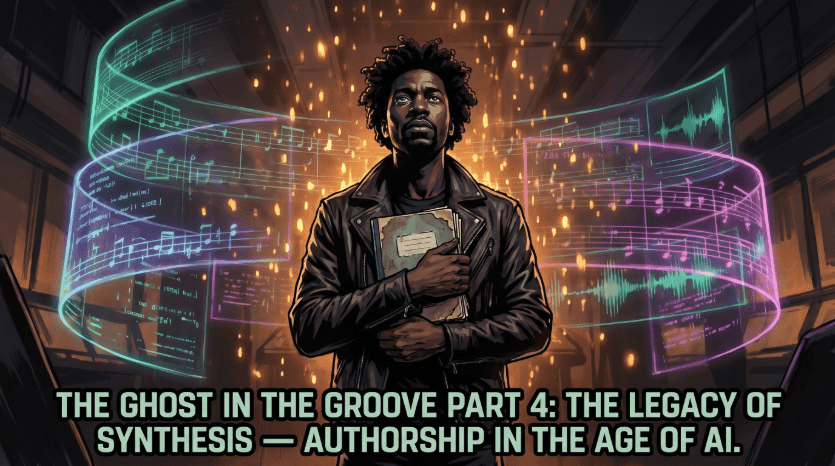
Part 4: The Legacy of Synthesis
— Authorship in the Age of AI
The water-damaged notebook is closed now. It sits on the edge of the studio desk, its rippled pages finally at rest. The words it held—the poetry of a younger man, nearly lost to the floodwaters of 2017—have been translated, restructured, and directed. They have been given a new vessel. They have become K@MECRZE.
When I listen to the final tracks, I do not hear a machine. I hear the echo of my own survival, amplified and reflected back to me through a digital prism. But as the final chord fades into the silence of the studio, a larger, more daunting question remains hanging in the air:
In the age of artificial intelligence, the concept of authorship is undergoing a violent, necessary evolution. As creators, we are standing at the edge of a profound paradigm shift. The tools we use are no longer just passive instruments; they are active participants in the creative process. And this shift terrifies many of us. It feels like a loss of control. It feels like a threat to the very soul of art.
But what if we are looking at it the wrong way? What if the machine is not here to replace the artist, but to liberate the storyteller?

The Anxiety of the Algorithm
The fear surrounding AI in creative fields is rooted in a fundamental misunderstanding of what art actually is. We often confuse the execution of art with the essence of art.
If you believe that the value of a song lies entirely in the physical dexterity required to play a guitar, then yes, an AI that can generate a flawless guitar solo in seconds is a threat. But if you believe that the value of a song lies in the human experience that necessitated the song in the first place—the heartbreak, the joy, the trauma, the triumph—then the AI is simply a new kind of amplifier.
The machine does not know what it feels like to watch the floodwaters rise. It does not know what it feels like to peel apart the pages of a ruined archive and find your childhood handwriting staring back at you. It only knows the parameters I gave it.
The emotion, the context, the why—that is entirely human. The AI is the brush; I am still the painter. The AI is the ensemble; I am still the director. The authorship belongs to the one who lived the story.
A Lantern for the Unheard
This realization is not just a philosophical comfort; it is a radical democratization of expression.
For decades, the ability to create high-quality music, film, and design has been gatekept by access to resources. You needed expensive studio time, session musicians, technical training, and industry connections. If you had a brilliant story to tell but lacked the technical proficiency to execute it, your story often remained untold.
AI changes that equation entirely. It lowers the barrier to execution, allowing the creator to focus entirely on the essence.
Think of the poet who has never learned to play an instrument, but whose words carry the rhythm of a symphony. Think of the grandmother with a lifetime of stories, who can now use these tools to score the soundtrack of her memories. Think of the young writer who can now build an entire sonic universe from their bedroom.
These tools are not replacing human creativity; they are providing a lantern for the unheard. They are allowing people to share their true light in formats that were previously inaccessible to them.
The Next Generation of Storytellers
As we move forward into this new era, the definition of a "recording artist" or a "designer" will inevitably change. The premium will no longer be placed solely on technical execution, because technical execution will be ubiquitous.
Instead, the premium will be placed on vision. It will be placed on vulnerability. It will be placed on the ability to curate, direct, and synthesize. The artists who thrive in the age of AI will be the ones who understand that the machine is a collaborator, not a competitor. They will be the ones who know how to translate the page, how to direct the digital ensemble, and how to infuse the algorithm with the undeniable weight of human experience.
The Ghost in the Groove is not the AI. The ghost is the human spirit, haunting the code, demanding to be felt.
My notebook survived the flood so that it could teach me this lesson. The water took the physical artifacts, but it could not take the story. And now, thanks to the synthesis of human emotion and artificial intelligence, that story has a sound that will outlast us all.
The studio monitors power down. The amber lamp clicks off. But the music is still playing.